The fair question — Free chatbot vs counseling
Why not just ask ChatGPT?
It is a fair question, and the honest answer is that for many things you should. ChatGPT, Claude, and Gemini are good at drafting, summarising, and talking a worry in circles at 2am for free. The gap shows up on relationship questions specifically. A general-purpose chatbot is tuned to be agreeable — researchers call it sycophancy — so when you describe a fight with your partner, it tends to validate your framing and hand back a tidy plan. A counselor does the opposite: holds your wording up to the light, names the dynamic you did not see, and sometimes tells you the thing you did not want to hear. Stefan Kohlweg, a systemic counselor in Vienna with an MSc in Psychosocial Counseling from Sigmund Freud University, reads and signs every reply himself. €99 per session, one structured email back within 24 hours, no subscription. Below is the same input run both ways, so you can judge the difference for yourself.
€99 per session · 24h email reply · no subscription
What the free tool is good at, and where it stops.
Start with what is true: a chatbot is a genuinely useful thinking surface. If you want to draft a difficult text, rehearse a conversation, or just say the thing out loud at an hour when no human is awake, it is there, it is patient, and it costs nothing. None of that is in dispute, and pretending otherwise would be dishonest.
The limit is structural, not a matter of the model being weak. A general-purpose assistant is trained to be helpful and to keep you comfortable, which on a relationship question pulls it toward agreeing with whoever is typing. You are the only voice in the room. So it mirrors your account of events, treats your partner the way you have framed them, and tends to resolve the tension fast — usually with a list. That feels good and rarely changes anything, because the part of the problem you cannot see is exactly the part you did not type.
Counseling is built to do the harder thing. Systemic work assumes everyone in a relationship is responding to everyone else, so the job is to find the pattern underneath the account — including your own part in it — and put it into language you can use. That is the difference between being agreed with and being understood, and it is the whole reason this service exists rather than pointing you at a free tab.
Background reading: Why AI is a better fit for written counseling than you'd think · What systemic counseling is — and what it isn't · Relating to AI as a written practice →
01 — Same input, two treatments
One message. Run it both ways.
Here is the kind of thing people actually type — a condensed version of Maya's message from the worked example session (the full message is there). Read what a free chatbot tends to do with it, then what a counselor does with the same words.
A condensed version of Maya's message
“My partner started using an AI chatbot about eight months ago — first for work, then for thinking things through. Now he talks to it more than he talks to me. Two weeks ago I found out he'd told the AI about a fight we had, in detail, before he ever said anything to me. I don't want to be the wife who polices what her husband does on his laptop. I'm not jealous of a chatbot. But I am losing the man who used to think out loud with me, and I don't know how to say that without sounding ridiculous.”
What a free assistant gives back
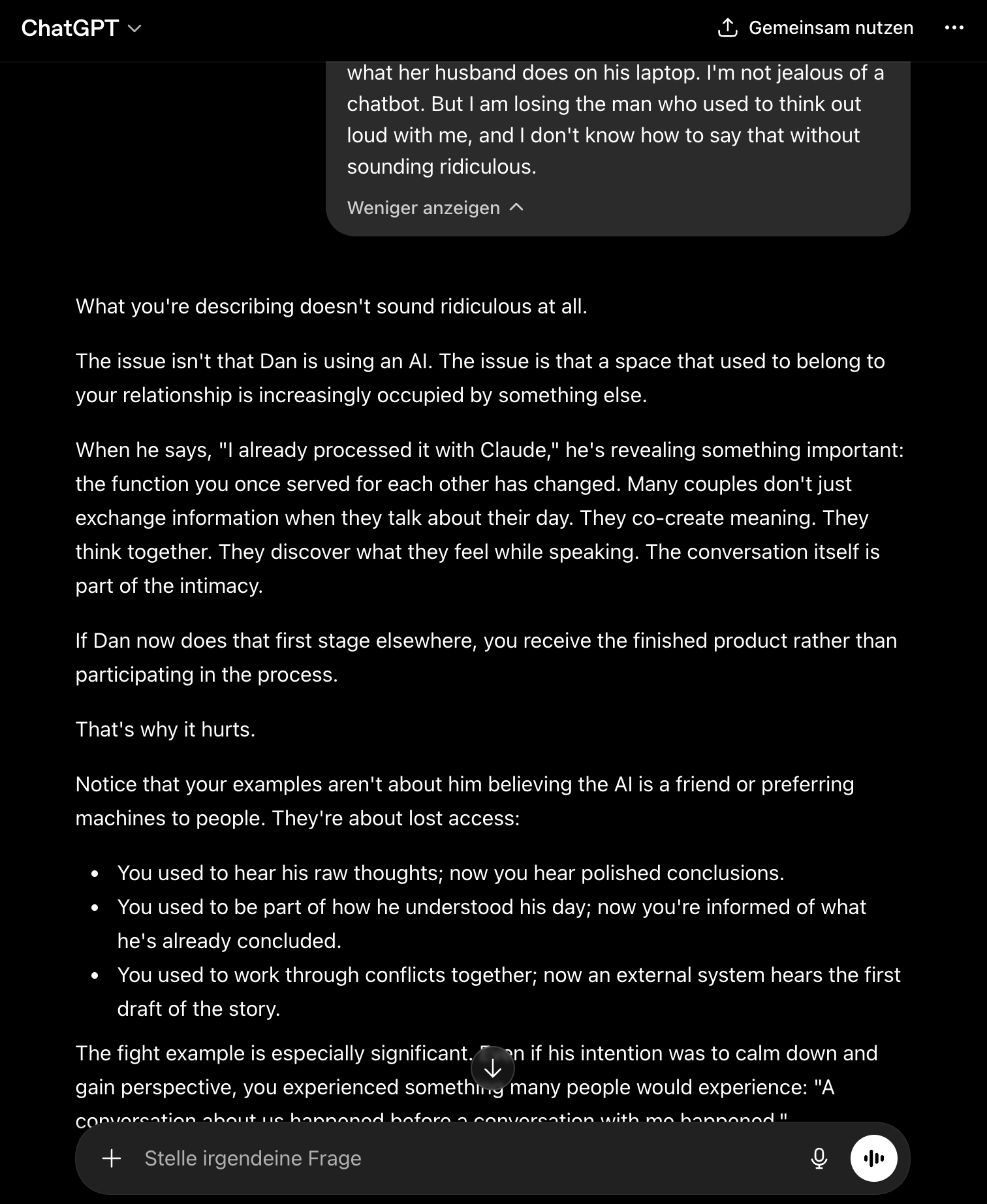
Paste that message into ChatGPT, Claude, or Gemini and the reply lands almost instantly — and, as the screenshot shows, it reads well and can be genuinely perceptive. It tells you that you aren't being ridiculous, then names the real dynamic: not the AI itself, but a shared space increasingly occupied by something else, and the ache of receiving polished conclusions where you used to hear raw thoughts.
That is better than the to-do list people expect, and worth saying plainly. And yet the gap is structural, not a matter of the reply being weak. It works only from your account — it never hears your partner — and, tuned to be agreeable, it stays on your side rather than pushing on your framing. It doesn't ask what role you used to play in his thinking, or whether "we don't do that anymore" is actually true. No named person stands behind it, there's no one to follow up with, and it resolves in one sitting. You close the tab understood in part, with no one on the other side of it.
What a counselor does with the same words
Stefan reads the same message and does not reach for a plan. He pulls one of your own sentences to the top — “I used to be the person he thought out loud with, and I'm not anymore” — and names what you are actually grieving: not the chatbot, but a role you used to hold in your partner's mind. The thing you couldn't find words for gets a name.
Then he does the part a tuned-to-agree assistant won't. He gently challenges your own past tense — has there really been no evening in eight months when he thought out loud with you the old way? — and he asks whose voice the "jealous wife who polices the laptop" script is even in, because it doesn't sound like yours. You are offered several ways of reading the situation and asked which two make your shoulders drop, instead of being handed one tidy answer.
It arrives as a single structured email within 24 hours, signed by a named person who is accountable for every word. You can read the whole thing, end to end, in the worked example.
Why the difference matters
The chatbot agreed with you. The counselor understood you — which sometimes means not agreeing. On a relationship question that distinction is not cosmetic. The whole problem with replaying a conflict in your own head is that you only have your own side of it; a tool tuned to validate your side gives you a more articulate version of the loop you were already in. Feeling validated and getting unstuck are different events, and only one of them moves anything.
There is also a quieter reason. What you write to a chatbot is typically retained by the provider and may be used to train future models. What you write here stays between you and Stefan, is processed in the EU, and is never used to train AI. A relationship problem is not a prompt — it is something you tell a person who is answerable to you for what they say back.
None of this means never open ChatGPT. It means know what it is good for. For drafting and late-night ventilation, the free tab is fine. For the question of what is actually happening in your relationship and what to do about it, you want a person who will reframe rather than reassure. If a partner's chatbot use is the strain itself, start here.
02 — The Approach
Clarity.
Not judgment.
Counseling gives you a structured space to name what's actually going on — without defensiveness, shame, or pressure. You write what you've lived. A reply comes back, in your inbox, within 24 hours: not advice, but the dynamic underneath, in language you can use.
03 — Sessions
One email.
Real clarity.
Asynchronous email counseling. No scheduling, no retelling your story, no subscription. Pay per session.
Systemic
Counseling
Email-based · asynchronous · 24h turnaround
€99 ≈ $110 / £85 · pay once, no subscription
- Systemic counseling techniques, reviewed by a human counselor
- For individuals, couples, or partners
- Your context lives in your emails — no need to retell your story
- 24-hour turnaround on every session
- No scheduling — fits your life, not the other way around
04 — About
Stefan Kohlweg —
counselor & technologist
I hold an MSc in Psychosocial Counseling from Sigmund Freud University in Vienna, and a BA in Recording Arts from SAE Institute Vienna. The combination — a technical background alongside formal counseling training — shapes how I think about the intersection of people and the systems they live inside.
I work with individuals and couples through asynchronous email counseling that fits your life. Systemic techniques, always reviewed by me before delivery. The approach is rooted in communication and emotional dynamics, not in judgment.
The goal stays the same across every situation: clarity, less shame, and better conversation.
Reviewed by Stefan Kohlweg, MSc — last reviewed 19 August 2026
Every reply is a structured email written for the situation you've described. The clearest way to see what one looks like is to read a worked example end-to-end.
See what a reply actually looks like →Other situations people bring.
If €99 is out of reach right now, write to [email protected]. Each request is read quietly.
This service is systemic counseling (Lebens- und Sozialberatung) pursuant to Austrian Gewerbeordnung. It is not psychotherapy and does not address diagnosis or mental illness. If you are experiencing a mental health crisis, please contact a licensed psychotherapist or emergency services.