Re: Your session — what you're losing has a shape
Please take 10–15 minutes for yourself with this email. Find a quiet moment, somewhere you won't be interrupted, and read it slowly. This response is designed for reflection, not skimming. You can come back to it more than once — most people do.
Dear Maya,
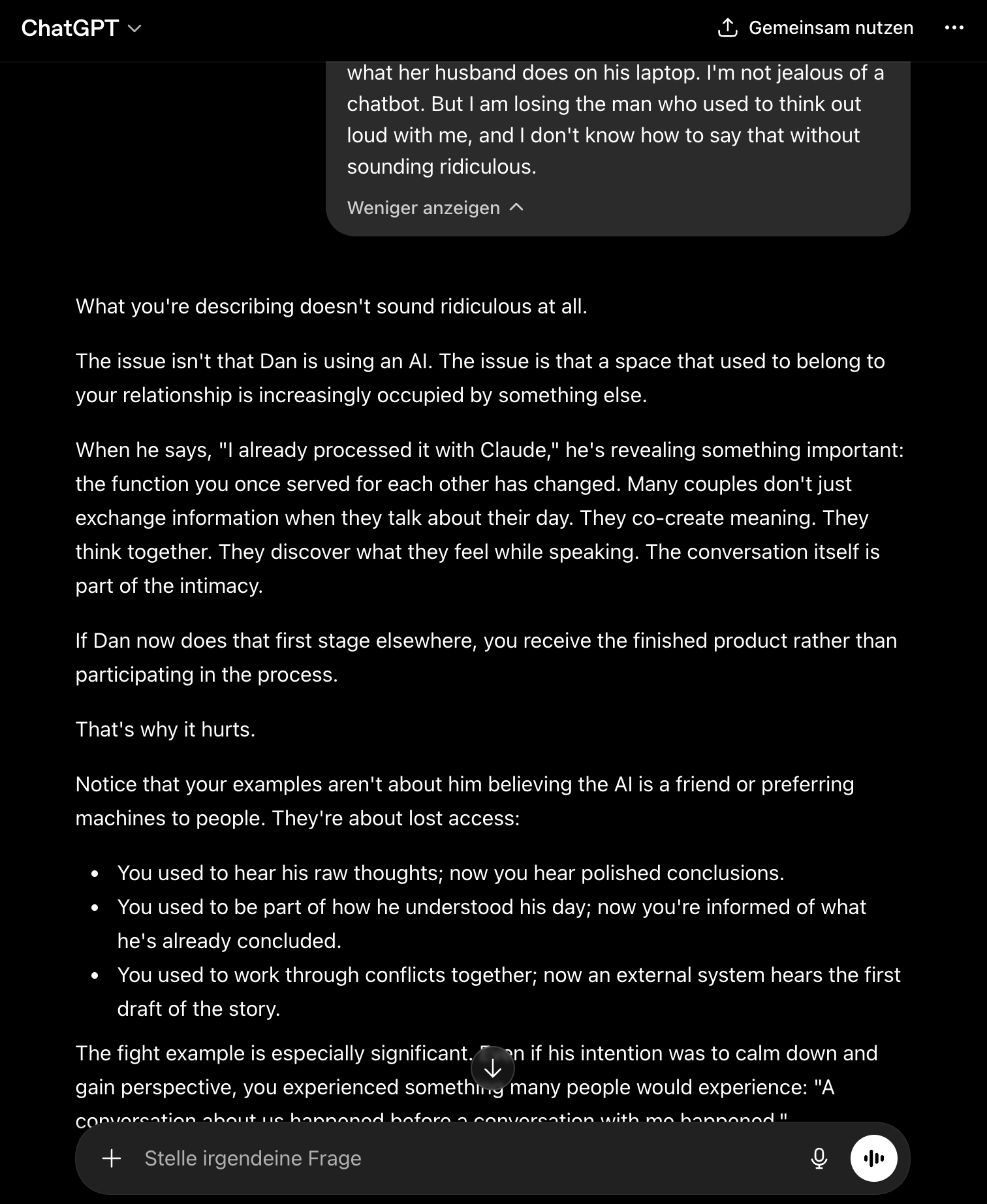
Thank you for writing, and for writing the way you did. I want to start by saying: what you sent me is not the message of someone being weird about technology. It is the message of someone who has been paying very close attention to her marriage for a long time, and who has noticed something real.
You wrote one sentence that I want to put at the top of this letter, because I think it is the most important thing you said:
"I used to be the person he thought out loud with, and I'm not anymore."
Not the AI. Not the fight he debriefed before debriefing it with you. The lost role. You are not grieving a tool. You are grieving a place you used to occupy in your husband's mind — the place where his half-formed thoughts went before they became conclusions. You called it "thinking out loud together." That is a specific, beautiful, four-year-built thing, and you are right that it has gone quiet.
I also want to honor how carefully you've protected him in the way you described this. You went out of your way to say the AI use isn't secret, isn't sexual, isn't replacing anything you can name. You have refused, even in private to me, to make him a villain. That restraint is not weakness. It is the same generosity that probably made you good at thinking out loud with him in the first place. I want to name it, because the dominant story right now is telling you that you are the one who is "being ridiculous," and the dominant story is wrong about you.
For the rest of this letter, I'd like to give the thing you're describing a working name, drawn from your own words. You said he comes to you "with a clear head" — already processed, already concluded. Let's call what has moved into your relationship The Pre-Processing. Not the AI itself. The Pre-Processing. The habit of arriving at conversations already finished. We can change the name later if it doesn't fit; for now it gives us something to look at together instead of looking at Dan.
Here are five different stories about what The Pre-Processing might be doing in your marriage. None of them are the answer. They are five different chapters from five different possible books, and I want you to notice which ones make your shoulders drop and which ones make them tense.
- The Story of the Audience Seat.
In this story, you and Dan used to be co-authors of his thinking, and now you have been quietly moved into the audience. He still loves the audience. He performs for the audience. But the audience does not get to interrupt, doesn't get to say "wait, what about—," doesn't get to change where the thought is going. You are not losing Dan. You are losing co-authorship of him.
Carry this question with you for a few days: when in the last week did you feel like a co-author rather than an audience? Even for thirty seconds. Write down what was happening.
- The Story of the Easier Listener.
In this story, The Pre-Processing did not arrive because something was wrong with you as a listener. It arrived because the AI is, by design, frictionless — it never gets tired, never has its own day, never needs anything back. Dan may not have noticed yet that he traded a listener with a soul for a listener with no needs, and that the trade quietly costs him the part of being heard that actually heals.
Question to sit with: what does Dan lose when he is heard by something that cannot be changed by hearing him?
- The Counter-Story (the one The Pre-Processing does not want you to tell).
You said you "used to debrief together." That sentence is in past tense, but I'd like to gently challenge the past tense. In the eight months since this began, has there been even one evening — one drive, one walk, one Sunday morning — when he thought out loud with you the old way? Not a perfect one. A flicker. The dominant story says "we don't do that anymore." A counter-story says "we do that less, and I have stopped counting the times we still do."
Which sentence is more accurate, on closer inspection?
- The Story of Who Benefits from Your Silence.
There is a quiet logic in your message: if you say something, you become "the wife who polices her husband's laptop." If you stay silent, you become invisible. The Pre-Processing benefits enormously from this bind — as long as the only available script is "jealous wife," you cannot speak. Whose voice is that script in? A sitcom's? A comment section's? Your mother's? Someone else's? Because it does not sound like yours.
If that script were not available to be used against you, what would you say to Dan tonight?
- The Cultural Story.
We are in the first generation of couples who have to figure out what it means when one partner builds a daily reflective practice with a non-human interlocutor. There is no inherited script for this — not from your parents, not from movies, not from your friends (yet). You are not behind. You are early. The fact that you don't have a word for what you're losing is not a personal failure of vocabulary. It is the accurate report of someone standing at the front edge of something new, trying to name it before the language exists.
If you were the person who got to coin the word for what you're feeling, what would the word be?
Of these five perspectives — which two feel closest to what you're experiencing? Let me know in your next reply which two you'd like to go deeper on, and I'll build from there. There are no right answers. The two that make something in your chest go "yes, that one" are the right two.
Before you close this email, one small thing to carry into the week. Not a task — an act of noticing. The Pre-Processing has been loud lately, and so its absence has probably gone unrecorded. This week, I would like you to keep a very short, very private list — phone notes, paper, anywhere — of moments when Dan thought out loud with you the old way. A half-formed thought at the kitchen counter. A "wait, what do you think about—" in the car. A question he asked you that he had not already answered. Even tiny ones. Especially tiny ones.
You are not collecting evidence to present to him. You are collecting evidence for yourself, that the thing you are grieving is not entirely gone — it has just gotten quieter, and quiet things need a witness to stay alive. Write back about what you noticed, even if the list is short. Especially if the list is short.
You will know better than I whether any of this fits. I may be over-weighting the "co-authorship" thread and under-weighting something else entirely — please correct me if so. The five stories above are offers, not diagnoses, and you are the only person in the room who knows which ones are true.
The book of your marriage is not finished, Maya. This is a strange chapter, written in a language none of us learned in school. But you are, very clearly, still one of its authors — and the fact that you wrote to me is itself a sentence in the next chapter.
I'm curious to hear which two stories you'd like to take further, and what the week of noticing brings.
Warmly,
Stefan